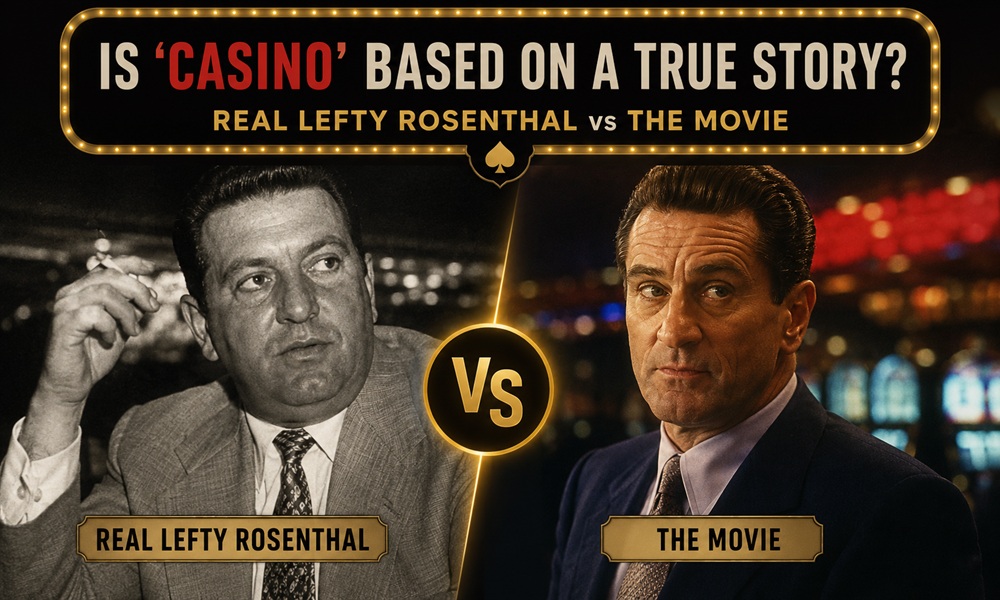
Quick answer: Yes. Martin Scorsese’s Casino (1995) is based on a true story. It adapts the real lives of Las Vegas oddsmaker Frank “Lefty” Rosenthal, mob enforcer Anthony “Tony the Ant” Spilotro, and Rosenthal’s wife Geri McGee. Scorsese and writer Nicholas Pileggi changed the names and compressed some events, but the core is real.
The film feels operatic, almost too dramatic to be real. That is the strange part. Most of the wild moments happened.
Casino is built on the nonfiction book Casino: Love and Honor in Las Vegas by Nicholas Pileggi, who also wrote the source material for Goodfellas. Pileggi spent years documenting the real Vegas skimming operation. The screenplay mostly just swapped the names.
Who are the real people behind the characters?
Every major character maps to a real person. This is not “inspired by.” It is a direct retelling with new names.
| Movie character | Actor | Real person |
|---|---|---|
| Sam “Ace” Rothstein | Robert De Niro | Frank “Lefty” Rosenthal |
| Nicky Santoro | Joe Pesci | Anthony “Tony the Ant” Spilotro |
| Ginger McKenna | Sharon Stone | Geri McGee |
| Philip Green | Kevin Pollak | Allen Glick |
Frank Rosenthal ran the Stardust and other casinos for the Chicago Outfit through the 1970s and 1980s. Spilotro was his childhood friend from Chicago and the muscle on the ground. Their friendship, and its collapse, drives the whole film.
What in ‘Casino’ really happened?
A surprising amount. Here are the beats the record backs up.
- The no-license problem. Rosenthal secretly ran multiple casinos while holding low-profile titles like food and beverage manager, because his mob ties meant he could never get a real gaming license. The film shows this almost exactly.
- The gaming ban. Nevada regulators barred Rosenthal from the industry, mirroring Rothstein’s downfall on screen.
- The affair. Spilotro really did have an affair with Rosenthal’s wife. It fractured the two men, just as the movie shows.
- The eye in the vise. Spilotro’s brutal reputation was real. Testimony in the Operation Family Secrets trial described the notorious vise torture, though the on-screen victim is a composite.
- The car bomb. Rosenthal survived a car bombing, and the movie recreates it.
- Geri’s death. Rosenthal’s ex-wife died of a drug overdose, echoing Ginger’s fate.
What did Scorsese change for the screen?
No adaptation is a documentary. The changes are mostly about geography, names, and compression.
- The names. All of them, to protect against legal exposure and to give Scorsese room to shape scenes.
- The cornfield killing. Spilotro and his brother really were beaten to death and buried in an Indiana cornfield. But testimony later showed the beating happened first in a basement in Illinois, then the bodies were moved. The film’s daylight cornfield scene is a dramatization.
- Composite characters. Some victims and side figures blend several real people into one.
- Timeline compression. Years of slow-burning conflict are tightened into a faster arc.
Did Frank Rosenthal think the movie was accurate?
He had mixed feelings. Rosenthal reportedly felt the film was largely accurate overall. His one firm objection: he insisted he never personally funneled casino profits to the mob, a claim the film leans into.
That single disagreement says a lot. The man whose life it depicted mostly recognized himself in it.
Rosenthal later worked as a nightclub manager and ran an online betting operation. He died of a heart attack in Miami Beach at age 79.
Where did the real story take place?
The heart of it was the Stardust on the Las Vegas Strip, the casino the “Tangiers” stands in for. The skimming scheme funneled untaxed cash from the count room back to Midwest crime families. When federal investigators cracked it, it helped end the mob’s grip on Las Vegas and opened the door to the corporate era that runs the city today.
That is the quiet epilogue the film gestures at in its final act: the old Vegas being demolished to make way for the new one.
What do fans say about the film’s accuracy?
Look through Reddit’s film and true-crime threads and a pattern shows up. Longtime Vegas locals and mob-history readers tend to praise Casino as one of the more faithful mob movies, precisely because Pileggi reported it out first. The common critique is not accuracy but length and pacing, not “they made it up.”
On Quora, a recurring question is whether the vise scene was real. The honest answer forum historians give: the act was real to Spilotro’s reputation, but the specific on-screen victim is dramatized.
The bottom line
Casino is based on a true story, and a remarkably faithful one for a Hollywood film. The names changed. A few scenes were relocated or compressed. But Lefty Rosenthal, Tony Spilotro, and the Vegas skimming empire were all real, and their story ended much the way the movie shows.
If you want the unfiltered version, Pileggi’s book is the primary source the whole film is built on.
Frequently asked questions
Is the movie Casino a documentary?
No. It is a dramatized film based on real events and real people, adapted from a nonfiction book.
Was Sam “Ace” Rothstein a real person?
Yes. He is based on Frank “Lefty” Rosenthal, a real Las Vegas casino boss and oddsmaker.
Did Nicky Santoro really exist?
Yes. He is based on mob enforcer Anthony “Tony the Ant” Spilotro.
Was Ginger a real person?
Yes. Sharon Stone’s character is based on Geri McGee, Rosenthal’s real wife.