
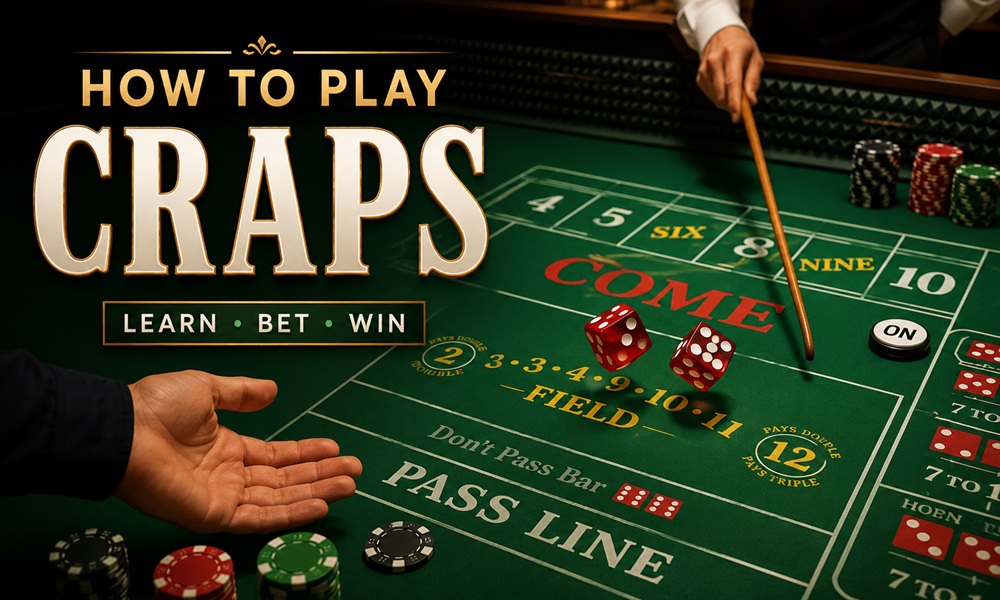
The craps table is the loudest, most intimidating spot on the casino floor. A crowd leans over the rail, chips fly everywhere, players shout numbers, and dealers move fast.
Here is the secret. Craps comes down to one bet, one concept, and about five minutes of reading. Ignore the chaos and the exotic wagers in the middle of the table. Learn the pass line, add an odds bet, and you can play with the regulars on your very first visit.
This guide walks you through the table, the crew, the dice, the core bets, and the etiquette that keeps you from becoming the story everyone tells later.
How does a game of craps work?
Craps is a dice game. Players bet on the outcome of two six-sided dice rolled by one player, called the shooter. Everyone at the table can bet, and the shooter role rotates around the rail.
The game runs in two phases.
1. The come-out roll. This is the opening roll of a round.
- Roll a 7 or 11 and pass line bets win instantly. This is called a “natural.”
- Roll a 2, 3, or 12 and pass line bets lose. This is “crapping out.”
- Roll a 4, 5, 6, 8, 9, or 10 and that number becomes the “point.”
2. The point phase. Once a point is set, the shooter keeps rolling. Now you want that point number to appear again.
- Roll the point before a 7, and pass line bets win.
- Roll a 7 first, and pass line bets lose. This is a “seven-out,” and the dice pass to the next shooter.
That is the entire heartbeat of the game. Everything else is optional.
What is the pass line bet?
The pass line is the long strip running along the front edge of the table, right in front of you. Roughly nine out of ten players put their first chip here.
To bet it, drop your chips on the “PASS LINE” area before the come-out roll. Then follow the two phases above.
Why start here? Three reasons:
- It is simple. Win on 7 or 11, lose on 2, 3, or 12, then chase the point.
- It has a low house edge of 1.41%, one of the best in the building.
- It needs no dealer interaction. Just place the chip and watch.
The payout is even money, or 1 to 1. Bet $10, win $10.
What is the odds bet, and why is it the best bet in the casino?
Once a point is established, you can add an “odds” bet directly behind your pass line chip. This is the hidden gem of craps.
The odds bet pays true mathematical odds, which means the house has zero edge on it. There is no other bet on the floor where the casino gives up its advantage entirely.
Here is how it pays, based on the point:
| Point number | Odds bet pays |
|---|---|
| 4 or 10 | 2 to 1 |
| 5 or 9 | 3 to 2 |
| 6 or 8 | 6 to 5 |
Casinos cap how much you can put on odds, usually as a multiple of your pass line bet (often 3x, 4x, or 5x). When you back a pass line bet with maximum odds at “3x-4x-5x” tables, the combined house edge on your total wager drops to as low as 0.37%. That is about as good as gambling gets.
Practical tip: keep your pass line bet small and reserve enough of your bankroll to back it with full odds. That structure gives you the most action at the lowest cost.
What other bets should beginners know?
Stick to a short list at first. These are the low-edge, beginner-friendly options.
- Come bet. Works exactly like a pass line bet but placed after a point is set. Each come bet creates its own personal point. You can back it with odds too.
- Don’t pass bet. The mirror image of the pass line. You are betting with the house, against the shooter. It carries an even lower edge at 1.36%, though cheering against the table can feel awkward.
- Place bets on 6 or 8. A steady option once you know the rhythm, with a 1.52% edge.
And here is what to avoid early on. The center of the table holds the “proposition” bets: hardways, horn bets, “any craps,” and single-roll wagers. They look tempting with flashy payouts. They also carry some of the worst house edges on the floor, in some cases well over 10%. The stickman controls that area and will happily take your bets there. For your first several sessions, ignore the entire center.
Who runs a craps table?
Four casino employees work every craps game. Knowing their roles makes you feel like a regular instead of a tourist.
| Role | What they do |
|---|---|
| Boxman | Sits in the middle behind the chips. Supervises the game, handles cash, settles disputes. |
| Stickman | Uses a curved stick to push the dice to the shooter and controls the center prop bets. |
| Two dealers | Stand on each side. They take your bets, pay winners, and help you place wagers you cannot reach. |
New players often ask which employee to talk to. Work with the dealer on your side of the table. Tell them what you want, and they will place and track bets for you. Tip them now and then, and they will guide you through the flow.
What is craps table etiquette?
Craps has more unwritten rules than almost any casino game, and beginners break them constantly. One widely shared cautionary tale describes a first-timer who hurled the dice into the chip stack, scattering everything and forcing a full reset, then overthrew the table on the next roll and hit another player. Do not be that person. Follow these:
- Buy in between rolls. Lay your cash on the table between shooters and let the dealer give you chips. Never hand cash to the dealer directly.
- Handle the dice with one hand only. Cameras watch for this. Using two hands or taking the dice off the table can pause the game.
- Throw so the dice hit the back wall. A roll that reaches the far wall counts as fair. Weak tosses may be waved off.
- Do not throw over the chip stacks. Aim for a clear lane down the table.
- Never say the word “seven.” It is the ultimate table superstition. Once a point is set, saying “seven” is like inviting the loss that ends everyone’s roll. Regulars will groan.
- Keep your hands out of the “shooting lane.” When the shooter is about to roll, pull your hands back so you do not get hit or block the dice.
- Tip the crew. A small “dealer bet” on the pass line or a hardway is a friendly gesture, especially on a hot roll.
Why do players cheer at the craps table?
Craps is the most social game in the casino because most players bet the same way, on the pass line, rooting for the shooter. When the shooter gets hot and keeps hitting numbers, everyone at the rail wins together.
That shared momentum is the appeal. A long roll can turn strangers into a cheering section. When the dreaded 7 finally shows and the shooter “sevens out,” the table goes quiet and the dice move on.
A simple first-timer game plan
Keep it this simple your first night:
- Find a low-minimum, uncrowded table. Watch one full round.
- Buy in between shooters. Put cash on the felt, take your chips.
- Place a small pass line bet before the come-out roll.
- Once a point is set, add an odds bet behind it.
- Ignore the center of the table entirely.
- When it is your turn to shoot, use one hand and hit the back wall.
Do that, and you are playing real craps at close to the lowest house edge available.
Play within your limits
Craps moves fast, and money changes hands quickly. The pass line and odds combination keeps the casino’s edge low, but low is not zero, and no dice-throwing technique changes the math over time. Set a budget before you play, treat it as the price of a fun night, and walk away when you hit your limit.
If gambling stops feeling like entertainment, take a break and reach out to a support service in your area.
Frequently asked questions
Is craps hard to learn?
No. The pass line bet is one of the simplest wagers in the casino. The table looks complex because of all the optional bets, but you can ignore almost all of them.
What is the safest bet in craps?
The pass line backed by a free odds bet. The odds portion has no house edge at all, and the combined edge can drop to around 0.37% at 3x-4x-5x tables.
Do I have to roll the dice?
No. You can bet without ever shooting. When the dice come to you, you can politely decline and they pass to the next player.
What does “snake eyes” mean?
It is slang for rolling two ones, a total of 2. On the come-out roll, that is one of the ways to “crap out.”
Why can’t I say “seven” at the table?
Pure superstition, but it is taken seriously. After a point is set, a 7 ends the roll and busts most bets, so players treat the word as bad luck.